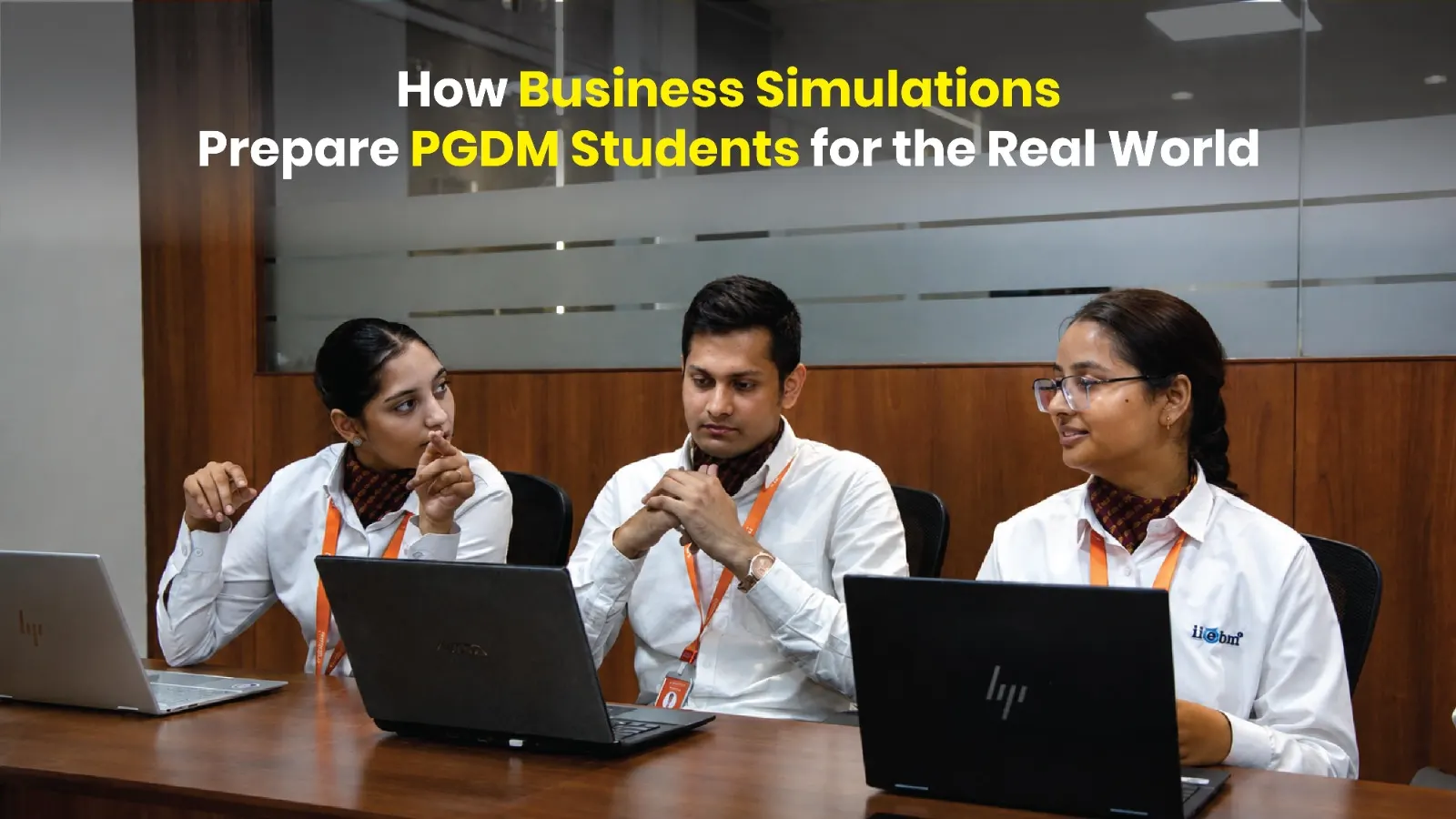
A PGDM at IIEBM Indus Business School is beyond learning concepts from textbooks. To be able to succeed in the current competitive environment, students need opportunities to apply what they learn. They need to be able to make decisions, solve problems, and understand that their choices have consequences.
This is where business simulations in management education can make a significant impact.
By recreating real-world business scenarios in a controlled environment, simulations allow PGDM students to experience the challenges of managing a business without the risks associated with the real world. Let us take a look at how business simulations prepare PGDM students.
What Is A Business Simulation?
Business simulations are an interactive, experiential learning tool that imitates a real company or business situation in a controlled environment. Students can run a virtual company or department. It replaces static case studies with active, ‘learning by doing’ decision-making
Business simulations in management education help sharpen both hard skills such as financial analysis and business acumen, as well as soft skills such as teamwork and critical thinking. These transform students into more confident and capable decision makers ready for real business challenges.
How Do Business Simulations Prepare PGDM Students?
Develop Core Skills
There are certain core competencies that are developed through corporate simulation games in an MBA, such as business simulations. They include a mix of hard skills and soft skills. Hard skills include financial analysis, business acumen, strategic planning, and data interpretation. Soft skills include teamwork, communication, adaptability, and problem solving.
Safe Space for Failure
As these are simulations, students are empowered to make bolder decisions without the fear of real repercussions, such as job losses. That encourages creativity and bold decision making within the scope of the business simulation.
Teaches Data Driven Execution
Teams must analyse life reports and metrics to justify choices. That teaches students to use data for their decisions rather than rely on their gut feelings. This creates quantifiable results that are better for business outcomes.
They Break Silos
Businesses do not operate as separate entities, they are composed of several departments that work together harmoniously to keep everything functioning. Operations, Marketing, HR – they all work in tangent with each other. But subjects are traditionally taught separately. A marketing class at 11, then an accounts class at 12. Business simulations bring together different subjects and help students explore how each facet works with each other.
Teaches Students How To Deal With Unpredictable Curveballs
Business simulations throw unpredictable curveballs. These sudden changes lead to students having to look at real-life dashboards, interpret raw data, and pivot their strategy in seconds. Students learn to filter out unnecessary noise. That helps them become more agile and move according to the situation, as opposed to staying rigid in the face of change.
Developing Boardroom Dynamics
Everyone knows that soft skills are important. There is a lot of value in assessing raw human behaviour as well as charts and data. For example, watch what happens when students are put in a group and asked to outperform each other. Egos will clash, until someone steps up to take leadership. This replicates the dynamics in a boardroom, where students learn how to persuade peers by using data. Students practice disagreeing professionally.
Gives Students A Competitive Edge
When students are sitting for placements, the experiences they would have gained from business simulations would give them an added advantage over others. These simulations teach students the language of the recruiters and prepare them to give impressive interviews where they are confident, and genuine.
This is how business simulations prepare PGDM students for real corporate decisions.
They bridge the gap between classroom learning and the realities of the corporate world. These exercises give PGDM students the opportunity to develop technical knowledge while strengthening essential skills such as leadership, communication, teamwork, adaptability, and critical thinking.
More importantly, they teach students to make informed decisions under pressure, learn from failure, and adapt when circumstances change. Ultimately, business simulations provide PGDM students with a valuable competitive edge by transforming them from passive learners into active decision-makers who are ready to take on real business challenges.
At IIEBM, they know the importance of hands-on learning experiences. That is why they conduct experiential learning cases, simulations, and hackathons. These initiatives have earned IIEBM the title of ‘best PGDM college in Maharashtra’.
Are you looking for the best b-school in Pune? Reach out to IIEBM today and learn more about their PGDM courses.